Fred, or FRED, was an early chatbot written by Robby Garner. == History == The name Fred was initially suggested by Karen Lindsey, and then Robby jokingly came up with an acronym, "Functional Response Emulation Device." Fred has also been implemented as a Java application by Paco Nathan called JFRED Archived 2008-08-24 at the Wayback Machine. Fred Chatterbot is designed to explore Natural Language communications between people and computer programs. In particular, this is a study of conversation between people and ways that a computer program can learn from other people's conversations to make its own conversations. Fred used a minimalistic "stimulus-response" approach. It worked by storing a database of statements and their responses, and made its own reply by looking up the input statements made by a user and then rendering the corresponding response from the database. This approach simplified the complexity of the rule base, but required expert coding and editing for modifications. Fred was a predecessor to Albert One, which Garner used in 1998 and 1999 to win the Loebner Prize.
RagTime
RagTime is a frame-oriented business publishing software which combines word processing, spreadsheets, simple drawings, image processing, and charts, in a single document/program, integrated software. It is often used to create forms, reports, documentation, desktop publishing, and in office environments. Typical users are business clients, educational institutions, administrations, architects, and also private users. Ragtime includes the following modules: Page layout (forms, templates etc.) Word processing Image processing Spreadsheets, similar to Microsoft Excel Formulas and functions which can be used throughout, in text, graphics, and spreadsheets Charts in different types of diagrams Drawings in vector graphics including lines, polygons, Bézier curves and more Slide show (presentation of RagTime documents) Audio/video Buttons (pop-up menus, switches, and more) that can be used within RagTime documents Import/export of various file formats Support of the AppleScript scripting language available system-wide under macOS == Principle == RagTime differs from most other comparable programs or software packages in its strict frame-oriented design: all content is contained within frames on each page. The content can have a fixed position within its frame or, if it is text or a spreadsheet, flow into another frame that is connected to the first frame via a so-called “pipeline”. RagTime has no different document types for different types of data; all content is stored in a single compound document type. Thus, a RagTime document not only can contain multiple pages, but also multiple layouts within the same document; e.g. spreadsheets in addition to text and images. The RagTime filename extension is .rtd (RagTime document); for templates the extension is .rtt (RagTime template). The current version is RagTime 6.6.5. It is available for OS X (10.6-10.14) and Windows (XP/Vista/7/8/10). == Extensions == FileTime – allows accessing “FileMaker Pro” databases from RagTime documents under OS X RagTime Connect – ODBC database connection for RagTime 6 (Mac and Windows) Johannes – print extension for the simple creation of stapled or folded brochures, booklets etc. PowerFunctions – additional functions for a more effective creation of intelligent documents for exchanging data and for use in mixed Mac/Windows environments MetaFormula – SYLK-based extension that allows calculating text as formula == History == RagTime has been developed since 1985 for the Macintosh – originally named MacFrame – and was published in 1986. When released, it already had the present name, which was chosen following the then-available software package Lotus Jazz. In the European Macintosh market, RagTime quickly gained a prominent position that continues to this day, even though the market share has decreased. Despite repeated attempts, the program could not gain acceptance in the North American market due to its high cost ($395 in 1990). The North American sales office closed in 1991, shortly after Claris Corporation released ClarisWorks which duplicated much of the functionality of RagTime for a lower price. After the manufacturer – first Brüning & Everth, followed by B&E Software and today RagTime.de Development – had focused on the Macintosh only for a very long time, it also released a Windows version, RagTime 5.0, in 1999. However, the program could not assume great significance against established competitors, especially Microsoft Office. Until mid-2006 RagTime was, in addition to the commercial version, also available as a free version (RagTime Solo) for personal use. RagTime Solo included the same features and performance (except for spelling and Syllabification) dictionaries), but was not allowed for use in commercial environments. In other languages RagTime Solo was distributed as RagTime Privat. In a press release from July 5, 2006, RagTime announced the discontinuation of RagTime Solo: “… the RagTime Solo license conditions were often misinterpreted or deliberately flouted. Therefore we discontinued RagTime Solo, there will be no private version of RagTime 6 anymore.” After a successful start of the RagTime 6.0 software, sales edged significantly lower in the following years. Disagreements arose among the shareholders about the continuation of the company, which filed for bankruptcy in July 2007. As a result, the rights to RagTime were taken over by the newly established company RagTime.de Development GmbH, which was responsible for the development. The sales partner RagTime.de Sales GmbH distributed the RagTime products until October 2015. Today RagTime.de Development GmbH is also responsible for sales. The last level of development is the extensively revamped version RagTime 6.6 of 8 October 2015, which also includes new OS X features (e.g. high-resolution “Retina” displays) and supports Windows 10. == Programming == RagTime 1-3 were developed in Pascal, since version 4 the development is completely coded in C++. External programming and automation can be implemented via AppleScript on a Mac, and via OLE/COM-API (e.g. Visual Basic) under Windows. On a Mac, RagTime provides a comprehensive AppleScript library, for the automation of almost any task, from automatic document creation to the export of PDF documents. RagTime also supports “recordings” by use of the “AppleScript Editor”, which allows recording the interactive RagTime operation as an AppleScript program sequence. AppleScripts can be saved in the RagTime document and called via menu or shortcut keys. On Windows, RagTime (since version 6) disposes over an OLE/COM API, which allows automating many RagTime components via external programming. For that purpose there is a type library that installs the available RagTime OLE/COM object catalogue. Programming can be realized in all programming languages supported by Microsoft.
Long division
In arithmetic, long division is a standard division algorithm suitable for dividing multi-digit numbers that is simple enough to perform by hand. It breaks down a division problem into a series of easier steps. As in all division problems, one number, called the dividend, is divided by another, called the divisor, producing a result called the quotient. It enables computations involving arbitrarily large numbers to be performed by following a series of simple steps. The abbreviated form of long division is called short division, which is almost always used instead of long division when the divisor has only one digit. == History == Related algorithms have existed since the 12th century. Al-Samawal al-Maghribi (1125–1174) performed calculations with decimal numbers that essentially require long division, leading to infinite decimal results, but without formalizing the algorithm. Caldrini (1491) is the earliest printed example of long division, known as the Danda method in medieval Italy, and it became more practical with the introduction of decimal notation for fractions by Pitiscus (1608). The specific algorithm in modern use was introduced by Henry Briggs c. 1600. == Education == Inexpensive calculators and computers have become the most common tools for performing division in educational and professional contexts worldwide, reducing reliance on traditional paper-and-pencil techniques. Internally, these devices implement various division algorithms, many of which rely on iterative approximations and multiplication to improve computational efficiency. Educational approaches to teaching division vary across countries and regions, reflecting differing curricular priorities. In North America, long division has been de-emphasized or, in some cases, removed from portions of the curriculum as part of reform mathematics, which emphasizes conceptual understanding and the use of technology. In contrast, many education systems in Europe and Asia continue to emphasize mastery of standard algorithms, including long division, as a foundational arithmetic skill. For example, curricula in countries such as Japan and Germany typically introduce and reinforce long division during primary education, often alongside mental arithmetic strategies and problem-solving techniques. International assessments such as the Trends in International Mathematics and Science Study (TIMSS) highlight these differences, showing variation in how procedural fluency and conceptual understanding are balanced across educational systems. These differing approaches reflect broader educational philosophies regarding the balance between procedural fluency, conceptual understanding, and the role of technology in mathematics education. == Method == In English-speaking countries, long division does not use the division slash ⟨∕⟩ or division sign ⟨÷⟩ symbols but instead constructs a tableau. The divisor is separated from the dividend by a right parenthesis ⟨)⟩ or vertical bar ⟨|⟩; the dividend is separated from the quotient by a vinculum (i.e., an overbar). The combination of these two symbols is sometimes known as a long division symbol, division bracket, or even a bus stop. It developed in the 18th century from an earlier single-line notation separating the dividend from the quotient by a left parenthesis. The process is begun by dividing the left-most digit of the dividend by the divisor. The quotient (rounded down to an integer) becomes the first digit of the result, and the remainder is calculated (this step is notated as a subtraction). This remainder carries forward when the process is repeated on the following digit of the dividend (notated as 'bringing down' the next digit to the remainder). When all digits have been processed and no remainder is left, the process is complete. An example is shown below, representing the division of 500 by 4 (with a result of 125). 125 (Explanations) 4)500 4 ( 4 × 1 = 4) 10 ( 5 - 4 = 1) 8 ( 4 × 2 = 8) 20 (10 - 8 = 2) 20 ( 4 × 5 = 20) 0 (20 - 20 = 0) A more detailed breakdown of the steps goes as follows: Find the shortest sequence of digits starting from the left end of the dividend, 500, that the divisor 4 goes into at least once. In this case, this is simply the first digit, 5. The largest number that the divisor 4 can be multiplied by without exceeding 5 is 1, so the digit 1 is put above the 5 to start constructing the quotient. Next, the 1 is multiplied by the divisor 4, to obtain the largest whole number that is a multiple of the divisor 4 without exceeding the 5 (4 in this case). This 4 is then placed under and subtracted from the 5 to get the remainder, 1, which is placed under the 4 under the 5. Afterwards, the first as-yet unused digit in the dividend, in this case the first digit 0 after the 5, is copied directly underneath itself and next to the remainder 1, to form the number 10. At this point the process is repeated enough times to reach a stopping point: The largest number by which the divisor 4 can be multiplied without exceeding 10 is 2, so 2 is written above as the second leftmost quotient digit. This 2 is then multiplied by the divisor 4 to get 8, which is the largest multiple of 4 that does not exceed 10; so 8 is written below 10, and the subtraction 10 minus 8 is performed to get the remainder 2, which is placed below the 8. The next digit of the dividend (the last 0 in 500) is copied directly below itself and next to the remainder 2 to form 20. Then the largest number by which the divisor 4 can be multiplied without exceeding 20, which is 5, is placed above as the third leftmost quotient digit. This 5 is multiplied by the divisor 4 to get 20, which is written below and subtracted from the existing 20 to yield the remainder 0, which is then written below the second 20. At this point, since there are no more digits to bring down from the dividend and the last subtraction result was 0, we can be assured that the process finished. If the last remainder when we ran out of dividend digits had been something other than 0, there would have been two possible courses of action: We could just stop there and say that the dividend divided by the divisor is the quotient written at the top with the remainder written at the bottom, and write the answer as the quotient followed by a fraction that is the remainder divided by the divisor. We could extend the dividend by writing it as, say, 500.000... and continue the process (using a decimal point in the quotient directly above the decimal point in the dividend), in order to get a decimal answer, as in the following example. 31.75 4)127.00 12 (12 ÷ 4 = 3) 07 (0 remainder, bring down next figure) 4 (7 ÷ 4 = 1 r 3) 3.0 (bring down 0 and the decimal point) 2.8 (7 × 4 = 28, 30 ÷ 4 = 7 r 2) 20 (an additional zero is brought down) 20 (5 × 4 = 20) 0 In this example, the decimal part of the result is calculated by continuing the process beyond the units digit, "bringing down" zeros as being the decimal part of the dividend. This example also illustrates that, at the beginning of the process, a step that produces a zero can be omitted. Since the first digit 1 is less than the divisor 4, the first step is instead performed on the first two digits 12. Similarly, if the divisor were 13, one would perform the first step on 127 rather than 12 or 1. === Basic procedure for long division of n ÷ m === Find the location of all decimal points in the dividend n and divisor m. If necessary, simplify the long division problem by moving the decimals of the divisor and dividend by the same number of decimal places, to the right (or to the left), so that the decimal of the divisor is to the right of the last digit. When doing long division, keep the numbers lined up straight from top to bottom under the tableau. After each step, be sure the remainder for that step is less than the divisor. If it is not, there are three possible problems: the multiplication is wrong, the subtraction is wrong, or a greater quotient is needed. In the end, the remainder, r, is added to the growing quotient as a fraction, r⁄m. === Invariant property and correctness === The basic presentation of the steps of the process (above) focuses on what steps are to be performed, rather than the properties of those steps that ensure the result will be correct (specifically, that q × m + r = n, where q is the final quotient and r the final remainder). A slight variation of presentation requires more writing, and requires that we change, rather than just update, digits of the quotient, but can shed more light on why these steps actually produce the right answer by allowing evaluation of q × m + r at intermediate points in the process. This illustrates the key property used in the derivation of the algorithm (below). Specifically, we amend the above basic procedure so that we fill the space after the digits of the quotient under construction with 0's, to at least the 1's place, and include those 0's in the numbers we write below the division bra
Ontology engineering
In computer science, information science and systems engineering, ontology engineering is a field which studies the methods and methodologies for building ontologies, which encompasses a representation, formal naming and definition of the categories, properties and relations between the concepts, data and entities of a given domain of interest. In a broader sense, this field also includes a knowledge construction of the domain using formal ontology representations such as OWL/RDF. A large-scale representation of abstract concepts such as actions, time, physical objects and beliefs would be an example of ontological engineering. Ontology engineering is one of the areas of applied ontology, and can be seen as an application of philosophical ontology. Core ideas and objectives of ontology engineering are also central in conceptual modeling. Ontology engineering aims at making explicit the knowledge contained within software applications, and within enterprises and business procedures for a particular domain. Ontology engineering offers a direction towards solving the inter-operability problems brought about by semantic obstacles, i.e. the obstacles related to the definitions of business terms and software classes. Ontology engineering is a set of tasks related to the development of ontologies for a particular domain. Automated processing of information not interpretable by software agents can be improved by adding rich semantics to the corresponding resources, such as video files. One of the approaches for the formal conceptualization of represented knowledge domains is the use of machine-interpretable ontologies, which provide structured data in, or based on, RDF, RDFS, and OWL. Ontology engineering is the design and creation of such ontologies, which can contain more than just the list of terms (controlled vocabulary); they contain terminological, assertional, and relational axioms to define concepts (classes), individuals, and roles (properties) (TBox, ABox, and RBox, respectively). Ontology engineering is a relatively new field of study concerning the ontology development process, the ontology life cycle, the methods and methodologies for building ontologies, and the tool suites and languages that support them. A common way to provide the logical underpinning of ontologies is to formalize the axioms with description logics, which can then be translated to any serialization of RDF, such as RDF/XML or Turtle. Beyond the description logic axioms, ontologies might also contain SWRL rules. The concept definitions can be mapped to any kind of resource or resource segment in RDF, such as images, videos, and regions of interest, to annotate objects, persons, etc., and interlink them with related resources across knowledge bases, ontologies, and LOD datasets. This information, based on human experience and knowledge, is valuable for reasoners for the automated interpretation of sophisticated and ambiguous contents, such as the visual content of multimedia resources. Application areas of ontology-based reasoning include, but are not limited to, information retrieval, automated scene interpretation, and knowledge discovery. == Languages == An ontology language is a formal language used to encode the ontology. There are a number of such languages for ontologies, both proprietary and standards-based: Common logic is ISO standard 24707, a specification for a family of ontology languages that can be accurately translated into each other. The Cyc project has its own ontology language called CycL, based on first-order predicate calculus with some higher-order extensions. The Gellish language includes rules for its own extension and thus integrates an ontology with an ontology language. IDEF5 is a software engineering method to develop and maintain usable, accurate, domain ontologies. KIF is a syntax for first-order logic that is based on S-expressions. Rule Interchange Format (RIF), F-Logic and its successor ObjectLogic combine ontologies and rules. OWL is a language for making ontological statements, developed as a follow-on from RDF and RDFS, as well as earlier ontology language projects including OIL, DAML and DAML+OIL. OWL is intended to be used over the World Wide Web, and all its elements (classes, properties and individuals) are defined as RDF resources, and identified by URIs. OntoUML is a well-founded language for specifying reference ontologies. SHACL (RDF SHapes Constraints Language) is a language for describing structure of RDF data. It can be used together with RDFS and OWL or it can be used independently from them. XBRL (Extensible Business Reporting Language) is a syntax for expressing business semantics. == Methodologies and tools == DOGMA KAON OntoClean HOZO Protégé (software) Large language models == In life sciences == Life sciences is flourishing with ontologies that biologists use to make sense of their experiments. For inferring correct conclusions from experiments, ontologies have to be structured optimally against the knowledge base they represent. The structure of an ontology needs to be changed continuously so that it is an accurate representation of the underlying domain. Recently, an automated method was introduced for engineering ontologies in life sciences such as Gene Ontology (GO), one of the most successful and widely used biomedical ontology. Based on information theory, it restructures ontologies so that the levels represent the desired specificity of the concepts. Similar information theoretic approaches have also been used for optimal partition of Gene Ontology. Given the mathematical nature of such engineering algorithms, these optimizations can be automated to produce a principled and scalable architecture to restructure ontologies such as GO. Open Biomedical Ontologies (OBO), a 2006 initiative of the U.S. National Center for Biomedical Ontology, provides a common 'foundry' for various ontology initiatives, amongst which are: The Generic Model Organism Project (GMOD) Gene Ontology Consortium Sequence Ontology Ontology Lookup Service The Plant Ontology Consortium Standards and Ontologies for Functional Genomics and more
Tuple
In mathematics, a tuple is a finite sequence (or ordered list) of numbers. More generally, it is a sequence of mathematical objects, called the elements of the tuple. An n-tuple is a tuple of n elements, where n is a non-negative integer. There is only one 0-tuple, called the empty tuple. A 1-tuple and a 2-tuple are commonly called a singleton and an ordered pair, respectively. The term "infinite tuple" is occasionally used for "infinite sequences". Tuples are usually written by listing the elements within parentheses "( )" and separated by commas; for example, (2, 7, 4, 1, 7) denotes a 5-tuple. Other types of brackets are sometimes used, although they may have a different meaning. An n-tuple can be formally defined as the image of a function that has the set of the first n natural numbers as its domain (1, 2, ..., n). Tuples may be also defined from ordered pairs by a recurrence starting from an ordered pair; indeed, an n-tuple can be identified with the ordered pair of its (n − 1) first elements and its nth element, for example, ( ( ( 1 , 2 ) , 3 ) , 4 ) = ( 1 , 2 , 3 , 4 ) {\displaystyle \left(\left(\left(1,2\right),3\right),4\right)=\left(1,2,3,4\right)} . In computer science, tuples come in many forms. Most typed functional programming languages implement tuples directly as product types, tightly associated with algebraic data types, pattern matching, and destructuring assignment. Many programming languages offer an alternative to tuples, known as record types, featuring unordered elements accessed by label. A few programming languages combine ordered tuple product types and unordered record types into a single construct, as in C structs and Haskell records. Relational databases may formally identify their rows (records) as tuples. Tuples also occur in relational algebra; when programming the semantic web with the Resource Description Framework (RDF); in linguistics; and in philosophy. == Etymology == The term originated as an abstraction of the sequence: single, couple/double, triple, quadruple, quintuple, sextuple, septuple, octuple, ..., n‑tuple, ..., where the prefixes are taken from the Latin names of the numerals. The unique 0-tuple is called the null tuple or empty tuple. A 1‑tuple is called a single (or singleton), a 2‑tuple is called an ordered pair or couple, and a 3‑tuple is called a triple (or triplet). The number n can be any nonnegative integer. For example, a complex number can be represented as a 2‑tuple of reals, a quaternion can be represented as a 4‑tuple, an octonion can be represented as an 8‑tuple, and a sedenion can be represented as a 16‑tuple. Although these uses treat ‑tuple as the suffix, the original suffix was ‑ple as in "triple" (three-fold) or "decuple" (ten‑fold). This originates from medieval Latin plus (meaning "more") related to Greek ‑πλοῦς, which replaced the classical and late antique ‑plex (meaning "folded"), as in "duplex". == Properties == The general rule for the identity of two n-tuples is ( a 1 , a 2 , … , a n ) = ( b 1 , b 2 , … , b n ) {\displaystyle (a_{1},a_{2},\ldots ,a_{n})=(b_{1},b_{2},\ldots ,b_{n})} if and only if a 1 = b 1 , a 2 = b 2 , … , a n = b n {\displaystyle a_{1}=b_{1},{\text{ }}a_{2}=b_{2},{\text{ }}\ldots ,{\text{ }}a_{n}=b_{n}} . Thus a tuple has properties that distinguish it from a set: A tuple may contain multiple instances of the same element, so tuple ( 1 , 2 , 2 , 3 ) ≠ ( 1 , 2 , 3 ) {\displaystyle (1,2,2,3)\neq (1,2,3)} ; but set { 1 , 2 , 2 , 3 } = { 1 , 2 , 3 } {\displaystyle \{1,2,2,3\}=\{1,2,3\}} . Tuple elements are ordered: tuple ( 1 , 2 , 3 ) ≠ ( 3 , 2 , 1 ) {\displaystyle (1,2,3)\neq (3,2,1)} , but set { 1 , 2 , 3 } = { 3 , 2 , 1 } {\displaystyle \{1,2,3\}=\{3,2,1\}} . A tuple has a finite number of elements, while a set or a multiset may have an infinite number of elements. == Definitions == There are several definitions of tuples that give them the properties described in the previous section. === Tuples as functions === The 0 {\displaystyle 0} -tuple may be identified as the empty function. For n ≥ 1 , {\displaystyle n\geq 1,} the n {\displaystyle n} -tuple ( a 1 , … , a n ) {\displaystyle \left(a_{1},\ldots ,a_{n}\right)} may be identified with the surjective function F : { 1 , … , n } → { a 1 , … , a n } {\displaystyle F~:~\left\{1,\ldots ,n\right\}~\to ~\left\{a_{1},\ldots ,a_{n}\right\}} with domain domain F = { 1 , … , n } = { i ∈ N : 1 ≤ i ≤ n } {\displaystyle \operatorname {domain} F=\left\{1,\ldots ,n\right\}=\left\{i\in \mathbb {N} :1\leq i\leq n\right\}} and with codomain codomain F = { a 1 , … , a n } , {\displaystyle \operatorname {codomain} F=\left\{a_{1},\ldots ,a_{n}\right\},} that is defined at i ∈ domain F = { 1 , … , n } {\displaystyle i\in \operatorname {domain} F=\left\{1,\ldots ,n\right\}} by F ( i ) := a i . {\displaystyle F(i):=a_{i}.} That is, F {\displaystyle F} is the function defined by 1 ↦ a 1 ⋮ n ↦ a n {\displaystyle {\begin{alignedat}{3}1\;&\mapsto &&\;a_{1}\\\;&\;\;\vdots &&\;\\n\;&\mapsto &&\;a_{n}\\\end{alignedat}}} in which case the equality ( a 1 , a 2 , … , a n ) = ( F ( 1 ) , F ( 2 ) , … , F ( n ) ) {\displaystyle \left(a_{1},a_{2},\dots ,a_{n}\right)=\left(F(1),F(2),\dots ,F(n)\right)} necessarily holds. Tuples as sets of ordered pairs Functions are commonly identified with their graphs, which is a certain set of ordered pairs. Indeed, many authors use graphs as the definition of a function. Using this definition of "function", the above function F {\displaystyle F} can be defined as: F := { ( 1 , a 1 ) , … , ( n , a n ) } . {\displaystyle F~:=~\left\{\left(1,a_{1}\right),\ldots ,\left(n,a_{n}\right)\right\}.} === Tuples as nested ordered pairs === Another way of modeling tuples in set theory is as nested ordered pairs. This approach assumes that the notion of ordered pair has already been defined. The 0-tuple (i.e. the empty tuple) is represented by the empty set ∅ {\displaystyle \emptyset } . An n-tuple, with n > 0, can be defined as an ordered pair of its first entry and an (n − 1)-tuple (which contains the remaining entries when n > 1): ( a 1 , a 2 , a 3 , … , a n ) = ( a 1 , ( a 2 , a 3 , … , a n ) ) {\displaystyle (a_{1},a_{2},a_{3},\ldots ,a_{n})=(a_{1},(a_{2},a_{3},\ldots ,a_{n}))} This definition can be applied recursively to the (n − 1)-tuple: ( a 1 , a 2 , a 3 , … , a n ) = ( a 1 , ( a 2 , ( a 3 , ( … , ( a n , ∅ ) … ) ) ) ) {\displaystyle (a_{1},a_{2},a_{3},\ldots ,a_{n})=(a_{1},(a_{2},(a_{3},(\ldots ,(a_{n},\emptyset )\ldots ))))} Thus, for example: ( 1 , 2 , 3 ) = ( 1 , ( 2 , ( 3 , ∅ ) ) ) ( 1 , 2 , 3 , 4 ) = ( 1 , ( 2 , ( 3 , ( 4 , ∅ ) ) ) ) {\displaystyle {\begin{aligned}(1,2,3)&=(1,(2,(3,\emptyset )))\\(1,2,3,4)&=(1,(2,(3,(4,\emptyset ))))\\\end{aligned}}} A variant of this definition starts "peeling off" elements from the other end: The 0-tuple is the empty set ∅ {\displaystyle \emptyset } . For n > 0: ( a 1 , a 2 , a 3 , … , a n ) = ( ( a 1 , a 2 , a 3 , … , a n − 1 ) , a n ) {\displaystyle (a_{1},a_{2},a_{3},\ldots ,a_{n})=((a_{1},a_{2},a_{3},\ldots ,a_{n-1}),a_{n})} This definition can be applied recursively: ( a 1 , a 2 , a 3 , … , a n ) = ( ( … ( ( ( ∅ , a 1 ) , a 2 ) , a 3 ) , … ) , a n ) {\displaystyle (a_{1},a_{2},a_{3},\ldots ,a_{n})=((\ldots (((\emptyset ,a_{1}),a_{2}),a_{3}),\ldots ),a_{n})} Thus, for example: ( 1 , 2 , 3 ) = ( ( ( ∅ , 1 ) , 2 ) , 3 ) ( 1 , 2 , 3 , 4 ) = ( ( ( ( ∅ , 1 ) , 2 ) , 3 ) , 4 ) {\displaystyle {\begin{aligned}(1,2,3)&=(((\emptyset ,1),2),3)\\(1,2,3,4)&=((((\emptyset ,1),2),3),4)\\\end{aligned}}} === Tuples as nested sets === Using Kuratowski's representation for an ordered pair, the second definition above can be reformulated in terms of pure set theory: The 0-tuple (i.e. the empty tuple) is represented by the empty set ∅ {\displaystyle \emptyset } ; Let x {\displaystyle x} be an n-tuple ( a 1 , a 2 , … , a n ) {\displaystyle (a_{1},a_{2},\ldots ,a_{n})} , and let x → b ≡ ( a 1 , a 2 , … , a n , b ) {\displaystyle x\rightarrow b\equiv (a_{1},a_{2},\ldots ,a_{n},b)} . Then, x → b ≡ { { x } , { x , b } } {\displaystyle x\rightarrow b\equiv \{\{x\},\{x,b\}\}} . (The right arrow, → {\displaystyle \rightarrow } , could be read as "adjoined with".) In this formulation: ( ) = ∅ ( 1 ) = ( ) → 1 = { { ( ) } , { ( ) , 1 } } = { { ∅ } , { ∅ , 1 } } ( 1 , 2 ) = ( 1 ) → 2 = { { ( 1 ) } , { ( 1 ) , 2 } } = { { { { ∅ } , { ∅ , 1 } } } , { { { ∅ } , { ∅ , 1 } } , 2 } } ( 1 , 2 , 3 ) = ( 1 , 2 ) → 3 = { { ( 1 , 2 ) } , { ( 1 , 2 ) , 3 } } = { { { { { { ∅ } , { ∅ , 1 } } } , { { { ∅ } , { ∅ , 1 } } , 2 } } } , { { { { { ∅ } , { ∅ , 1 } } } , { { { ∅ } , { ∅ , 1 } } , 2 } } , 3 } } {\displaystyle {\begin{array}{lclcl}()&&&=&\emptyset \\&&&&\\(1)&=&()\rightarrow 1&=&\{\{()\},\{(),1\}\}\\&&&=&\{\{\emptyset \},\{\emptyset ,1\}\}\\&&&&\\(1,2)&=&(1)\rightarrow 2&=&\{\{(1)\},\{(1),2\}\}\\&&&=&\{\{\{\{\emptyset \},\{\emptyset ,1\}\}\},\\&&&&\{\{\{\emptyset \},\{\emptyset ,1\}\},2\}\}\\&&&&\\(1,2,3)&=&(1,2)\rightarrow 3&=&\{\{(1,2)\},\{(1,2),3\}\}\\&&&=&\{\{\{\{\{\{\empty
Robot Monk Xian'er
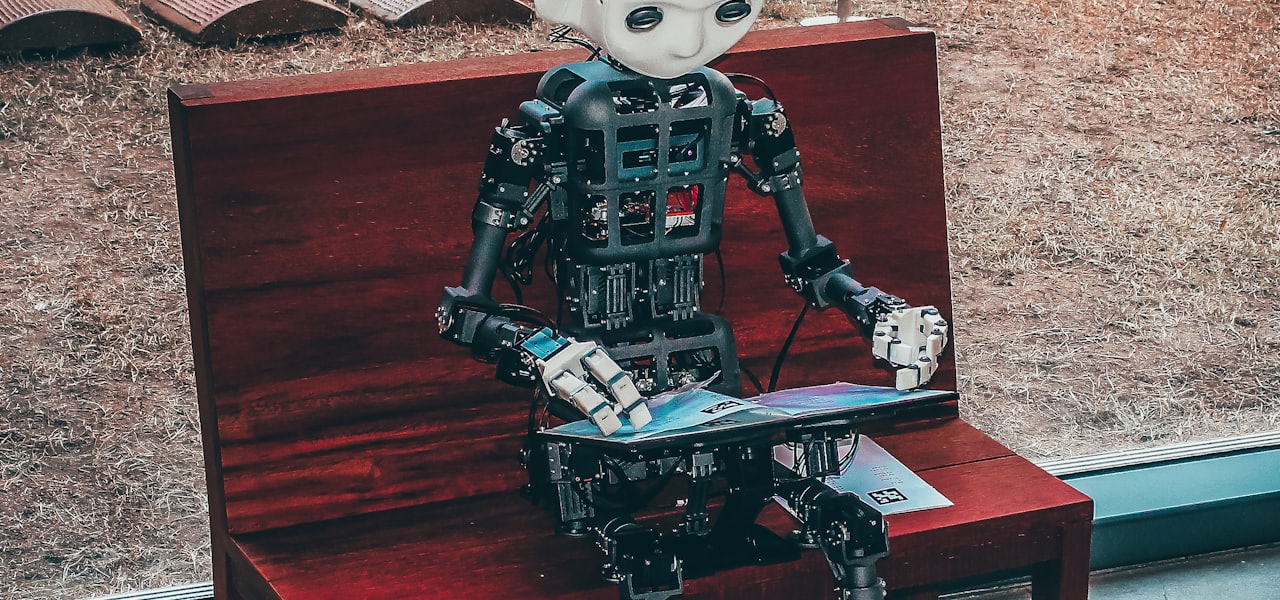
Robot Monk Xian'er (Chinese: 贤二机器僧) is a humanoid robot based on the cartoon character Xian'er. It was developed by a team of monks, volunteers and AI experts from Beijing Longquan Monastery in Beijing, China. He can follow human instructions to make body movements, read scriptures and play Buddhist music. He can chat and respond to people's emotional and spiritual questions with Buddhist wisdom. As a chatbot, Robot Monk Xian'er is available on certain public platforms including WeChat and Facebook. Over the years, master Xuecheng, the abbot of Beijing Longquan Monastery, replied to thousands of questions on Sina Weibo. These questions and their answers become the data source of the chatbot.
Certifying algorithm
In theoretical computer science, a certifying algorithm is an algorithm that outputs, together with a solution to the problem it solves, a proof that the solution is correct. A certifying algorithm is said to be efficient if the combined runtime of the algorithm and a proof checker is slower by at most a constant factor than the best known non-certifying algorithm for the same problem. The proof produced by a certifying algorithm should be in some sense simpler than the algorithm itself, for otherwise any algorithm could be considered certifying (with its output verified by running the same algorithm again). Sometimes this is formalized by requiring that a verification of the proof take less time than the original algorithm, while for other problems (in particular those for which the solution can be found in linear time) simplicity of the output proof is considered in a less formal sense. For instance, the validity of the output proof may be more apparent to human users than the correctness of the algorithm, or a checker for the proof may be more amenable to formal verification. Implementations of certifying algorithms that also include a checker for the proof generated by the algorithm may be considered to be more reliable than non-certifying algorithms. For, whenever the algorithm is run, one of three things happens: it produces a correct output (the desired case), it detects a bug in the algorithm or its implication (undesired, but generally preferable to continuing without detecting the bug), or both the algorithm and the checker are faulty in a way that masks the bug and prevents it from being detected (undesired, but unlikely as it depends on the existence of two independent bugs). == Examples == Many examples of problems with checkable algorithms come from graph theory. For instance, a classical algorithm for testing whether a graph is bipartite would simply output a Boolean value: true if the graph is bipartite, false otherwise. In contrast, a certifying algorithm might output a 2-coloring of the graph in the case that it is bipartite, or a cycle of odd length if it is not. Any graph is bipartite if and only if it can be 2-colored, and non-bipartite if and only if it contains an odd cycle. Both checking whether a 2-coloring is valid and checking whether a given odd-length sequence of vertices is a cycle may be performed more simply than testing bipartiteness. Analogously, it is possible to test whether a given directed graph is acyclic by a certifying algorithm that outputs either a topological order or a directed cycle. It is possible to test whether an undirected graph is a chordal graph by a certifying algorithm that outputs either an elimination ordering (an ordering of all vertices such that, for every vertex, the neighbors that are later in the ordering form a clique) or a chordless cycle. And it is possible to test whether a graph is planar by a certifying algorithm that outputs either a planar embedding or a Kuratowski subgraph. The extended Euclidean algorithm for the greatest common divisor of two integers x and y is certifying: it outputs three integers g (the divisor), a, and b, such that ax + by = g. This equation can only be true of multiples of the greatest common divisor, so testing that g is the greatest common divisor may be performed by checking that g divides both x and y and that this equation is correct.